


That’s a good sign, right?
The Dig (PC, 1996)
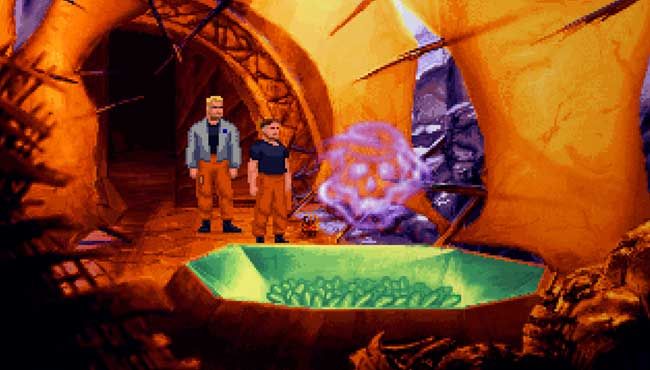
Originally pitched by Steven Spielberg and written by Orson Scott Card, The Dig’s development was stalled with numerous management changes and creative reboots, eventually reaching the finish line under Sean Clark’s watch. An asteroid named Attila (after the Hun, that’s right) is on its way to decimate all life on Earth and you’re in charge of shifting it into a stable orbit using nukes. You play the cool-as-a-cucumber mission commander Boston Low, voiced by Terminator 2‘s Robert Patrick (I’m a fan!), as he guides his team, including geologist Gunther Brink and linguist Maggie Robbins. A linguist? Well, as it turns out, the government is suspect of Attila’s origins and as you find yourself deep inside the asteroid, you manage to activate some mechanism that converts Attila into a massive crystal ship, sending you to an abandoned alien world where glowing green crystals can mend wounds or, even worse, resurrect you in the event you perish.
The game’s incredible art direction, filled with shiny things, weird creatures and distinct sights (its prismatic and glittery box is one of my favorite game packages) hails as one-of-a-kind to this day, perhaps the peak of LucasArts’ artistic powers. The story grows dark as Gunther becomes obsessed with these green crystals, the very things that unraveled their creators’ society, driving them away to another dimension entirely. As low, you’ll work to gain access to each spire that surrounds the landing site (despite the fact that Gunther and Maggie seemed to have had no issues) using a massive underwater tram network. Being new to adventure games, The Dig’s abstract puzzles mandated a strategy guide, which was also cleverly written to be Low’s personal journal. It’s not LucasArts’ best release, but it’s perhaps their most distinct and polished adventure.
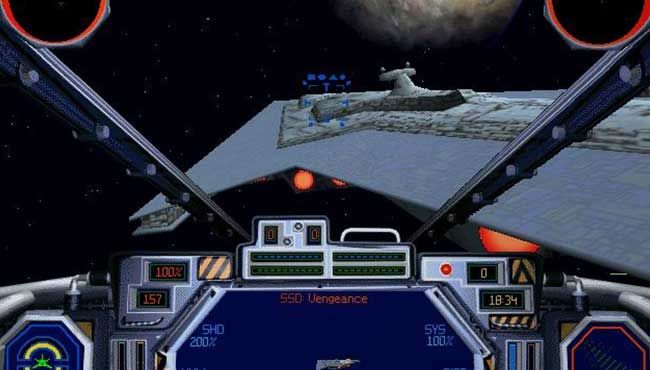
The game’s Balance of Power expansion introduced the eight-kilometer Super Dreadnought. Oh, my yes.
Star Wars: X-Wing vs. TIE Fighter (PC, 1997)
After TIE Fighter released, we had two big asks of the franchise. First, we should be able to get out of our fighter and navigate through the capital ships/planetary bases we’re assigned to. Second, add multiplayer. While the former wouldn’t really come to reality until nearly a decade later with Star Wars: Battlefront II, which in its best days was only a fraction of LucasArts’ abilities, the latter made X-Wing vs. TIE Fighter a day one purchase. With our house now wired for LAN play amongst a bunch of computers, the whole family (mom would sadly sit out) would dogfight out in the farthest reaches of space or complete a variety of standalone missions. The game was an obvious visual improvement over its predecessors, but it was distinct for being one of the first Star Wars games to shed the originally-composed MIDI tunes of its predecessors in favor of orchestral themes ripped straight from the films, which often became an odd fit.
The game had one glaring omission: a narrative. by including much-wanted multiplayer, the game ditched the series’ traditional campaign structure in favor of the previously mentioned standalone instances and individual deathmatches. This provided little long-term incentive to play the game and removed a lot of character from the game as well, leaving it as the least favorable of the series. LucasArts and developer Totally Games eventually released a campaign in the form of Balance of Power, but by then, the damage had already been done. Was it perhaps the first big misstep for LucasArts? Probably.
Poodoo!
Star Wars: Knights of the Old Republic (Xbox, 2003)
It’s a shame we had to advance so many years, past all those prequel trilogy tie-in games, to get to LucasArts’ next great achievement. Their best decision came in hiring famed RPG-maker Bioware to bring this game to life, which would later set the stage for developing a full MMO to flesh out their yarn. The next best decision came in allowing Bioware to build a story set in the expanded universe a full four-thousand years before the Battle of Yavin, allowing them to create whole new villains, settings, in an era where the Sith are a sizable faction in the galaxy.
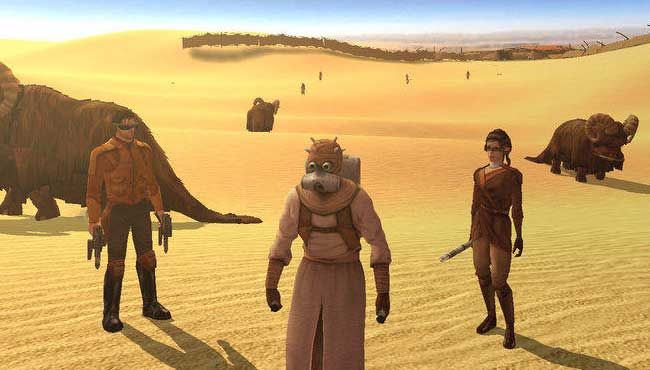
You start out as a customizable null character on a spaceship that’s being shred to bits. You crash land on the planet Taris, an ecumenopolis similar to Coruscant, and must begin to piece together your party amongst a variety of characters with interesting back stories. As Darth Malak levels Taris, you flee to the Jedi enclave on Dantooine and, in an incredible portion of the game, train to become a Jedi. You learn the Jedi ways, you harvest the crystals necessary to build (and later modify) your own lightsaber, then pass the Jedi trials. You must now hop from world to world in search of the Star Forge, a massive ancient facility that can help any willing party conquer the galaxy. The game’s thick atmosphere sent you to incredible settings, my favorite being the pristine water world Manaan, while decisions you made turned you toward the dark or light sides of the force, which activated their own talent trees and abilities.
KOTOR‘s story is the gem of its crown and it features to this day, the absolute best twist in a story ever as your character’s origins are revealed. I couldn’t see that coming if I tried. Sadly, on a subsequent playthrough a few years later, I was disappointed with how simple and linear the game was, leaving me to understand the complaints of the PC gamers who who really just wanted another Baldur’s Gate.
It’s a trap!
Star Wars: X-Wing Alliance (PC, 1999)
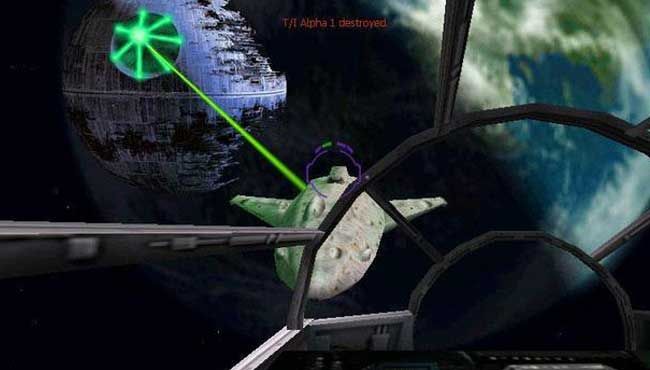
 Keith’s Pick: X-Wing Alliance is every Star Wars geek’s fantasy: you assume the role of a no-named character only to become part of the Rebel Alliance and take down the second Death Star. That’s right, the plot of Alliance entwines with the original trilogy films. You even get to assist Shadows of the Empire‘s Dash Rendar in a mission! (Don’t worry, I squealed at the thought too.) The fact of the matter is, the plot really made you feel like you were a part of this family caught in the middle of the war amongst the stars.
Not only was everything great about the gameplay from previous games carried over and refined, but new elements of the space simulation were introduced too.


Don't Keep This a
Secret, Share It